
Guía de descarboxilación de cannabis: Cómo activar THC para comestibles
Guía de descarboxilación de cannabis: Cómo activar THC para comestibles
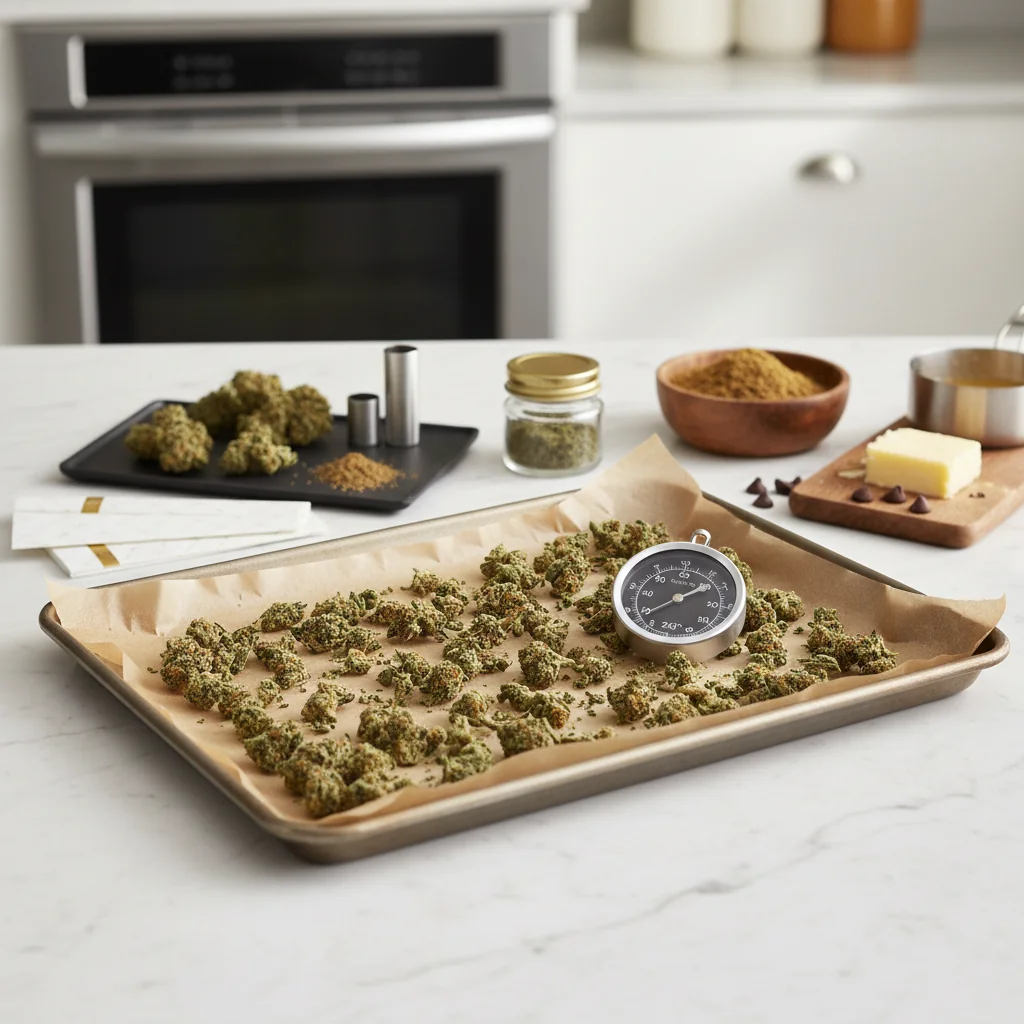
INGEL [ [ 0]]Si alguna vez has intentado hacer comestibles simplemente mezclando el cannabis crudo con tu batido de brownie, probablemente hayas notado algo decepcionante: no funcionaron. Eso es porque el cannabis crudo contiene THCA, no THC, y THCA no te drogará. Para desbloquear el potencial psicoactivo de tu cannabis, primero debes descarboxilarlo.
INGEL [ [ 0]]Esta guía explica la ciencia detrás de la descarboxilación y proporciona instrucciones paso a paso para activar adecuadamente su cannabis para comestibles, tinturas y tópicos.
respuesta rápida
INGEL [ [ 0]]Descarboxilación ("Descarbing") es el proceso de calentamiento de cannabis para convertir THCA en THC. Para descarrilar, esparza el cannabis molido en una bandeja para hornear y hornea a 115 °C (240 °F) durante 30-40 minutos. El calor elimina un grupo carboxilo de THCA, convirtiéndolo en THC psicoactivo. Este paso es esencial antes de hacer comestibles, manteca de cannabis o tinturas.
tabla de contenido
INGEL [ [ 0]] [ [1]]¿Qué es la descarboxilación?
¿Qué es la descarboxilación?
INGEL [ [0]] La descarboxilación es una reacción química que elimina un grupo carboxilo (COOH) de una molécula. En el cannabis, este proceso convierte los cannabinoides ácidos en sus formas activas.
La ciencia explicó
INGEL [ [ 0]]Flor de cannabis fresca contiene principalmente [ [ 1]]THCA (ácido tetrahidrocannabinólico), no THC. THCA tiene un grupo carboxilo extra unido a su estructura molecular. Este grupo carboxilo evita que THCA se una efectivamente a los receptores CB1 en su cerebro, por lo que comer cannabis crudo no produce un subidón.
INGEL [ [ 0]]Cuando se aplica calor:
1. El grupo carboxilo se vuelve inestable
2 . Se descompone como CO2 (dióxido de carbono) y vapor de agua
3. THCA se convierte en THC
4. THC ahora puede unirse a los receptores CB1 y producir efectos psicoactivos
Más allá del THC
INGEL [ [ 0]]La descarboxilación también afecta a otros cannabinoides:
- [ [ 0]]CBDA → CBD: activa los beneficios terapéuticos
- [ [ 0]]CBGA → CBG: convierte el "madre cannabinoide"
- [ [ 0]]THCVA → THCV: activa este cannabinoide energizante
Por qué la descarte es esencial
para comestibles
INGEL [ [ 0]]Cuando fumas o vapes el cannabis, el calor de la llama o el vaporizador descarboxica instantáneamente los cannabinoides. Pero al hacer comestibles, está agregando cannabis a alimentos que pueden nunca alcanzar las temperaturas adecuadas de descarboxilación, o solo brevemente durante la cocción.
INGEL [ [ 0]]La masa de Brownnie, por ejemplo, podría alcanzar los 350 ° F en el exterior mientras el centro permanece más fresco. Este calentamiento inconsistente da como resultado una descarboxilación incompleta y comestibles débiles.
INGEL [ [ 0]]Descomposición predeterminada asegura:
- Conversión completa de THCA → THC
- Potencia constante en todos sus comestibles
- Máximo uso de su material de cannabis
- Efectos predecibles
para tinturas
INGEL [ [ 0]]Las tinturas basadas en alcohol no involucran calor durante el proceso de infusión. Sin pre-descarboxilación, extraería THCA en lugar de THC.
para temas
INGEL [ [ 0]]Si bien los tópicos no suelen producir efectos psicoactivos (el THC no se absorbe bien a través de la piel), algunos usuarios prefieren los cannabinoides activados por sus potenciales propiedades terapéuticas.
La temperatura y el tiempo perfectos
INGEL [ [ 0]]Conseguir la temperatura y el tiempo correcto es crucial. Demasiado poco calor deja sin convertir thca; demasiado destruye THC y terpenos.
el punto dulce
INGEL [ [ 0]]Configuración recomendada:
- [ [ 0]]Temperatura: 230-250°F (110-121°C)
- [ [ 0]]Tiempo: 25-45 minutos
INGEL [ [ 0]]El protocolo más comúnmente recomendado: [ [ 1]]240°F durante 30-40 minutos
Gráfico de temperatura
INGEL [ [ 0]]
Qué sucede a diferentes temperaturas
INGEL [ [ 0]]Demasiado bajo ( [ [ 2]:
- Descarboxilación incompleta
- La mayoría de los THCA permanecen sin convertir
- comestibles débiles o inactivos
INGEL [ [ 0]][1]]Justo derecho (220-250°F):
- THCA ÓPTIMO → Conversión de TH
- Preservación de terpenos
- Resultados potentes y sabrosos
INGEL [ [ 0]]Demasiado alto (>280°F):
- THC comienza a degradarse a CBN
- terpenos destruidos
- Sabor más duro
- Efectos sedantes de CBN
Método de descarboxilación de horno
INGEL [ [0]]Este es el método más común y confiable para la descarboxilación del hogar.
lo que necesitarás
INGEL [ [ 0]] [ [1]]Flor de cannabis (cualquier cantidad)
Instrucciones paso a paso
INGEL [ [ 0]]#### Paso 1: Precalentar su horno
INGEL [ [ 0]]Ajuste su horno a 240°F (115°C). Use un termómetro de horno para verificar: muchos hornos se calientan o se enfrían. Deje 15-20 minutos para que el horno se estabilice.
INGEL [ [ 0]]#### Paso 2: Prepara tu cannabis
INGEL [ [0]]Descompone tu cannabis en pedazos más pequeños. PUEDES:
- Muélelo (aumenta el área de la superficie, descarbo más rápido)
- Romper a mano (menos fino, todavía funciona)
- Deje cogollos pequeños enteros (tarda un poco más)
INGEL [ [0]]No moler demasiado finamente: el polvo puede quemar en los bordes.
INGEL [ [ 0]]#### Paso 3: Preparar la bandeja para hornear
INGEL [ [ 0]]Línea una bandeja para hornear con papel pergamino o papel de aluminio. Unte el cannabis de manera uniforme en una sola capa. No apile ni se amontone.
INGEL [ [ 0]]Para la reducción del olor, puedes:
- Crea un paquete de aluminio (dobla el cannabis en papel de aluminio, los bordes de sellado)
- Usa una bolsa de horno
- Use un frasco de albañil con tapa colocada sin apretar
INGEL [ [ 0]]#### Paso 4: Hornear
INGEL [ [ 0]]Coloque la bandeja para hornear en el centro del horno. Hornear durante 30-40 minutos.
INGEL [ [ 0]][1]]Indicadores visuales de descarbos de acabado:
- El color cambia de verde brillante a marrón claro/dorado
- La textura se vuelve seca y desmenuzada
- Fuerte aroma a cannabis (esto es escapando de terpenos, cierta pérdida es normal)
INGEL [ [ 0]]#### Paso 5: Refrescar y almacenar
INGEL [ [ 0]]Retire del horno y deje enfriar completamente (15-30 minutos). El cannabis debe desmoronarse fácilmente cuando se toca.
INGEL [ [ 0]]Guarde en un recipiente hermético hasta que esté listo para usar. El cannabis decartado se puede almacenar como una flor normal: fresca, oscura y hermética.
Métodos alternativos de descarte
Método de tarro de albañil (olor reducido)
INGEL [ [ 0]]1. Coloque el cannabis roto en un frasco de albañil
2 Apriete la tapa con la mano (no demasiado apretado, la presión debe escapar)
3. Coloque el frasco en un plato apto para horno
4. Hornear a 240°F durante 40-45 minutos (el vaso tarda más en calentarse)
5. Agitar el frasco suavemente a la mitad
6. Dejar enfriar completamente antes de abrir
INGEL [ [ 0]][1]]beneficios: mucho menos olor se escapa de tu cocina
Método Sous Vide (más preciso)
INGEL [ [ 0]]1. Sellar el cannabis en una bolsa de vacío
2 . Establezca Sous Vide a 203°F (95°C)
3. Sumergir durante 90-120 minutos
4. Retire y seque
INGEL [ [ 0]][1]]beneficios: control de temperatura preciso, sin olor, máxima conservación de terpenos
Olla instantánea / olla a presión
INGEL [ [ 0]]1. Coloque el cannabis en el tarro de Mason en Instant Pot
2 Añade agua alrededor del frasco (no dentro)
3. Cocine a presión a fuego alto durante 40 minutos
4. Liberación de presión natural
5. Retire y seque si es necesario
INGEL [ [ 0]]Beneficios: resultados consistentes, ambiente sellado
Dispositivos de descarboxilación de Nova Ardent
INGEL [ [ 0]]dispositivos dedicados como el ardiente Nova automatiza el proceso:
- Operación con un solo botón
- Control de temperatura preciso
- conversión completa
- Sin olor
INGEL [ [ 0]][1]]beneficios: infalible, consistente, sin olor
Errores de descarte comunes
1. Inexactitud de la temperatura del horno
INGEL [ [ 0]]La mayoría de los hornos están a 10-25°F de su temperatura mostrada. Un termómetro de horno es una pequeña inversión que evita los lotes en ruinas.
2. Abrir el horno con frecuencia
INGEL [ [ 0]]Cada vez que abres el horno, la temperatura baja significativamente. Compruebe visualmente a través de la ventana cuando sea posible.
3. Saltar decarbo para "comerdibles de horno"
INGEL [ [ 0]]Pensando "los brownies se hornean a 350 ° F, eso lo descartará" es un error común. El tiempo de cocción es corto, las temperaturas internas varían y la masa húmeda no conduce el calor de manera eficiente.
4. moliendo demasiado fino
INGEL [ [ 0]]El polvo aumenta tanto el área de la superficie que los bordes pueden quemar antes de que se realicen los centros. Rompe en pedazos no más pequeños que el café molido grueso.
5. Demasiado calor tratando de acelerar
INGEL [ [ 0]]Temperatura más alta ≠ Resultados más rápidos. 300°F+ destruye THC más rápido de lo que lo activa.
6. Ignorar los cambios de color
INGEL [ [ 0]]El cannabis descartado adecuadamente debe ser dorado, no marrón oscuro o negro. El color oscuro significa sobre-descarboxilación y pérdida de potencia.
7 No permitir el enfriamiento completo
INGEL [ [ 0]]El cannabis caliente puede quemar los dedos y continúa liberando cannabinoides. Deje que se enfríe completamente antes de manipular.
Después de la descarte: ¿Qué sigue?
INGEL [ [ 0]]Su cannabis decartado ahora está "activado" y listo para muchas aplicaciones:
Hacer mantequilla de canna
INGEL [ [ 0]]Infunde su cannabis descarnado en mantequilla para usar en cualquier receta:
1. Cocine a fuego lento decarnado cannabis en mantequilla (baja calor, 2-3 horas)
2. Colar el material vegetal
3. Refrigera
INGEL [ [ 0]]Ver nuestro completo [ [ 1]]Guía de CannaButter para obtener instrucciones detalladas.
Hacer aceite de cannabis
INGEL [ [ 0]] mismo proceso que la de la manteca de canna pero con aceite de coco, aceite de oliva o aceite MCT:
- Ideal para hornear y cocinar
- Puede ser utilizado en cápsulas
- Funciona para temas de actualidad
haciendo tinturas
INGEL [ [ 0]]Canabis descarnado empinado en alcohol de alta resistencia:
1. Combina cannabis y Everclear en frasco
2. Agitar periódicamente durante 24 horas a 2 semanas
3. Esfuerzo
4. Almacenar en botellas de gotero oscuro
consumo directo
INGEL [ [ 0]]El cannabis descarnado puede ser:
- espolvoreado en la comida
- Añadido a los batidos
- poner en cápsulas
- Comido directamente (no sabroso, pero funciona)
INGEL [ [0]]Como ya está activado, no se necesita más preparación.
Consejos profesionales
INGEL [ [ 0]]1. [ [ 1]]Utilice un termómetro de horno—es la mejor inversión individual para obtener resultados consistentes
2 . [ [ 0]]Grin después de descarte para facilitar el manejo del material seco
3. [ [ 0]]Guardar tallos para más tarde—Contienen cannabinoides y también se pueden descartar
4. [ [0]] Método de tarro de masón Reduce significativamente el olor a cocina
5. [ [ 0]]El color es tu guía—marrón dorado = hecho, marrón oscuro = sobredotado
6. [ [ 0]]Descarte extra y almacenar para proyectos futuros
7 . [ [0]]Etiqueta y fecha Tu cannabis decartado
8. [ [ 0]]Calcular la potencia antes de usar (consulte nuestro [ [2]]Guía de dosificación de comestibles)
9. [ [ 0]]bajo y lento es mejor que rápido y caliente
10. [ [ 0]]No desperdicies ABV—La yema vapeada se descompone parcialmente y se puede usar directamente
FAQ
¿Qué pasa si me salto la descarboxilación?
INGEL [ [ 0]]Sus comestibles serán muy débiles o inactivos. THCA no produce efectos psicoactivos, por lo que desperdiciarás tu cannabis. Siempre descargue primero para comestibles.
¿Puedo descarrilar en un microondas?
INGEL [ [ 0]]No se recomienda. Las microondas se calientan de manera desigual y pueden crear puntos calientes que destruyen los cannabinoides mientras dejan otras áreas sin convertir.
¿Huele la descarte?
INGEL [ [ 0]]Sí, significativamente. El proceso libera terpenos que crean un fuerte olor a cannabis. Use métodos de tarro de albañil o de sous vide para minimizar el olor, o prepárese para una cocina fragante.
¿Cómo sé cuándo está hecho?
INGEL [ [ 0]]Búsqueda: color marrón dorado, textura seca y desmenuzable y tamaño reducido. El fuerte olor inicial se suavizará a medida que los terpenos terminen de liberarse.
¿Puedo descarrilar demasiado?
INGEL [ [ 0]]sí. La descarbo excesiva convierte el THC en CBN (menos psicoactivo, más sedante). Si tu cannabis se vuelve marrón oscuro o negro, has ido demasiado lejos.
¿Cuál es el mejor cannabis para comestibles?
INGEL [ [ 0]]Cualquier cannabis funciona, pero un mayor contenido de THC significa menos flores necesarias para la potencia deseada. También se puede usar el recorte y el agitado, solo ajuste la cantidad.
¿El kief necesita ser descartado?
INGEL [ [ 0]]Sí, kief contiene tricomas concentrados con el mismo THCA que necesita conversión. Use temperaturas ligeramente más bajas (220 °F) ya que no hay material vegetal para el aislamiento.
¿Puedo descarbar concentrado?
INGEL [ [ 0]]sí. Extienda concentrado sobre papel pergamino y caliente a 220°F durante 20-25 minutos. Observe con cuidado: los concentrados pueden descomponer rápidamente.
idea de narración
INGEL [ [0]]La descarboxilación es el primer paso crítico para hacer que los comestibles, tinturas e infusiones de cannabis sean eficaces. Sin él, está trabajando con THCA en lugar de THC, y sus productos finales no producirán los efectos deseados.
INGEL [ [ 0]]El proceso es simple: 240°F durante 30-40 minutos en un horno estándar. Use un termómetro de horno, observe el cambio de color a marrón dorado y no apresure el proceso. El cannabis decallado debidamente abre un mundo de posibilidades para la cocina y elaboración del cannabis.
INGEL [ [ 0]]¿Listo para poner en uso el cannabis descarnado? MIRA NUESTRO [ [ 1]]receta de mantequilla de canna o explora nuestra [ [3]]Guía de dosificación de comestibles para garantizar que cree infusiones seguras y agradables.
Frequently Asked Questions
Sus comestibles serán muy débiles o inactivos. THCA no produce efectos psicoactivos, por lo que desperdiciarás tu cannabis. Siempre descargue primero.
Related Guides

Best Cannabis Brownies Recipe: Classic Pot Brownie Guide
Perfect cannabis brownies recipe with step-by-step instructions. Learn proper cannabutter ratios, baking temperatures, dosing calculations, and tips for consistent, delicious pot brownies.

Calculating THC Dosage in Edibles: The Complete Math Guide
Master the math behind cannabis edible dosing. Complete formulas for calculating THC content, extraction efficiency charts, worked examples, and a quick reference cheat sheet.

How to Make Cannabis Chocolate Truffles: Infused Confection Recipe
Elegant cannabis chocolate truffle recipe with precise dosing. No-bake ganache method using cannabis coconut oil. Coating options, flavor variations, and storage tips.