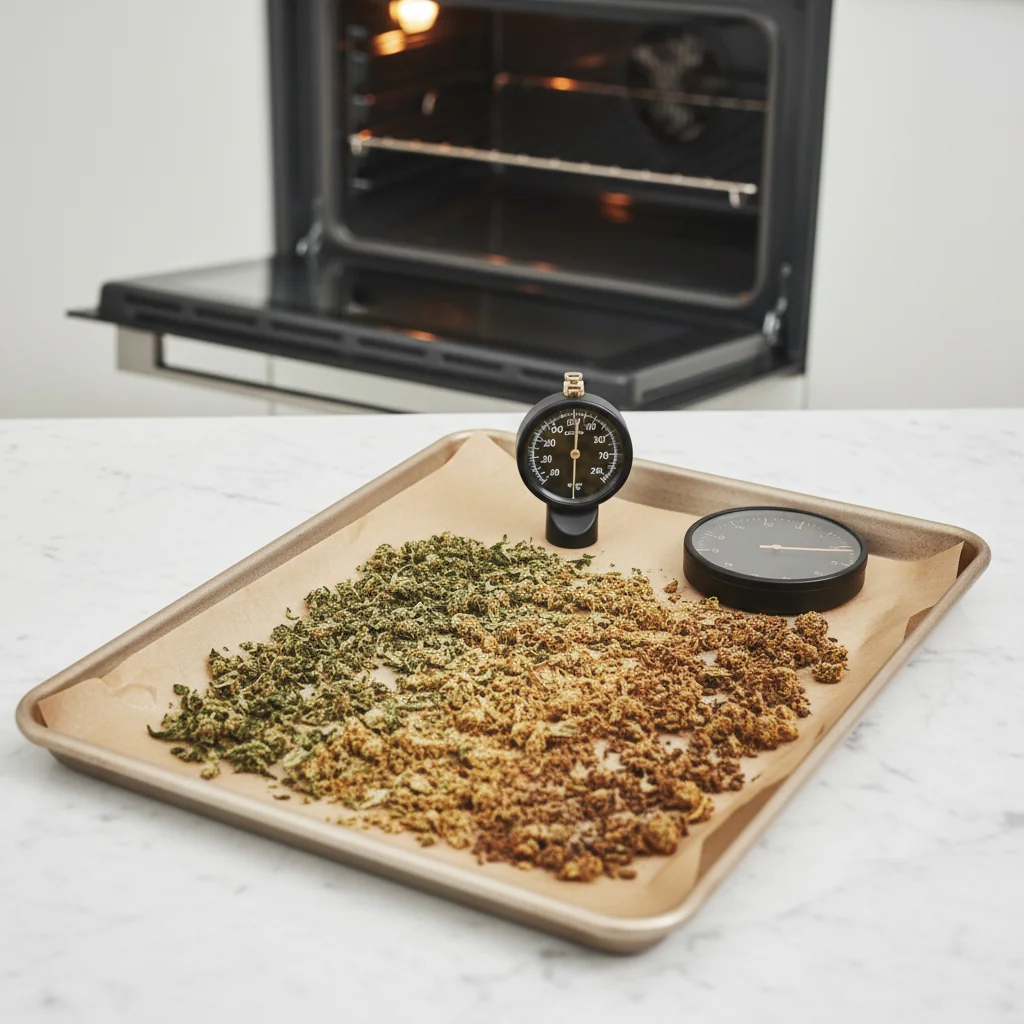
How to Decarboxylate Cannabis: Essential Activation Guide
Decarboxylation is the crucial first step in cannabis cooking that transforms inactive THCA into psychoactive THC. Without this process, your edibles will not produce the effects you expect.
Quick Answer
To decarboxylate cannabis: Preheat oven to 240°F (115°C), break cannabis into small pieces, spread on parchment-lined baking sheet, bake for 40-60 minutes until golden brown, then cool before using in recipes. This process activates THC for maximum potency in edibles.
What is Decarboxylation?
The Science Explained
Raw cannabis contains THCA (tetrahydrocannabinolic acid), a non-psychoactive compound. When exposed to heat, THCA loses a carboxyl group (CO2) and converts to THC, the compound that produces cannabis effects.
Without decarboxylation: Eating raw cannabis provides minimal effects because THCA does not cross the blood-brain barrier effectively.
With decarboxylation: THC becomes bioavailable, allowing your body to absorb and utilize it.
Why It Matters for Edibles
When you smoke cannabis, the lighter provides instant decarboxylation. Edibles skip this step, so you must decarb before infusing.
Proper decarb = potent edibles. Skipping this step is the most common mistake in cannabis cooking.
Step-by-Step Oven Method
What You Need
- Cannabis flower (any amount)
- Baking sheet
- Parchment paper or silicone mat
- Oven thermometer (highly recommended)
- Timer
Step 1: Preheat Your Oven
Set oven to 240°F (115°C). Use an oven thermometer to verify actual temperature. Many ovens run hot or cold.
Why 240°F: This temperature is hot enough to convert THCA efficiently but low enough to avoid destroying THC (which degrades above 315°F).
Step 2: Prepare the Cannabis
Break cannabis into pea-sized pieces. Do not grind finely - this can cause burning and makes straining harder later.
Tip: Remove any large stems but keep small pieces attached.
Step 3: Spread Evenly
Line baking sheet with parchment paper. Spread cannabis in a single, even layer. Avoid overlapping or piling.
Step 4: Bake for 40-60 Minutes
Place in preheated oven. Set timer for 40 minutes. Check at 40 minutes - cannabis should be golden brown with a toasted aroma.
Visual cues:
- Starting color: Bright green
- Halfway: Olive/medium green
- Done: Golden brown, slightly crispy
If still green at 40 minutes, continue checking every 10 minutes up to 60 minutes total.
Step 5: Cool Completely
Remove from oven and cool for at least 30 minutes. Cannabis will become slightly more brittle as it cools.
Do not grind while hot - moisture will condense and affect storage.
Alternative Decarboxylation Methods
Sous Vide Method
Advantages: Precise temperature control, contains odor, consistent results.
Process:
1. Set sous vide to 203°F (95°C)
2. Place cannabis in vacuum-sealed bag
3. Submerge for 90 minutes
4. Cool and use
Mason Jar Method
Advantages: Reduces odor, easy containment.
Process:
1. Place cannabis in mason jar
2. Loosely seal (do not fully tighten)
3. Bake at 240°F for 60 minutes
4. Shake jar halfway through
5. Cool before opening
Instant Pot/Pressure Cooker Method
Advantages: Fast, odor-controlled, consistent.
Process:
1. Place cannabis in mason jar inside pressure cooker
2. Add water to bottom of pot
3. Pressure cook on high for 40 minutes
4. Natural release
5. Cool and use
Time and Temperature Guide
Recommended: 240°F for 40-60 minutes balances efficiency, potency, and terpene preservation.
Signs of Proper Decarboxylation
Visual Indicators
Color change: From bright green to golden brown/olive
Texture: Slightly drier and more crumbly
Aroma: Toasted, herbal smell (different from fresh cannabis)
Common Problems
Still bright green after 60 minutes: Oven temperature too low. Verify with thermometer.
Turned dark brown/black: Oven too hot. THC may be degraded.
Uneven coloring: Not spread evenly or oven has hot spots.
Decarbing for Different Cannabinoids
THC Decarboxylation
Standard 240°F for 40-60 minutes converts THCA to THC optimally.
CBD Decarboxylation
CBD requires slightly higher temperatures or longer times. Try 250°F for 60-90 minutes for CBD-dominant strains.
CBN Production
Extended decarboxylation (270°F for 60+ minutes) converts some THC to CBN, which has sedative properties. Useful for sleep-focused edibles.
Storage After Decarboxylation
Short-term (1-2 weeks)
Store in airtight container at room temperature away from light.
Long-term (months)
Store in airtight container in freezer. Bring to room temperature before using.
Ready for Infusion
Decarbed cannabis is ready to infuse immediately into butter, oil, or other fats.
Tips for Best Results
Tip 1: Verify Oven Temperature
Use an oven thermometer. A 25°F difference can significantly affect results.
Tip 2: Do Not Over-grind
Pea-sized pieces work best. Fine grinding causes burning and makes straining difficult.
Tip 3: Watch for Color Change
Golden brown = done. Dark brown = overcooked.
Tip 4: Save the Kief Catcher
Kief decarbs faster (20-30 minutes at 240°F) due to smaller particle size.
Tip 5: Consider Odor
Decarboxylation produces strong cannabis odor. Plan accordingly for ventilation.
Troubleshooting
My edibles are not potent
- Did not decarb long enough
- Oven temperature was too low
- Skipped decarboxylation entirely
Cannabis turned very dark
- Temperature too high
- Left in oven too long
- THC likely degraded - still usable but less potent
Still smells very green
- Needs more time
- Temperature may be too low
Decarboxylation is essential for effective edibles. Once you master this step, your cannabis cooking will produce consistent, potent results.
Step 1: 明確
明確
Step 2: 明確
明確
Step 3: 明確
明確
Step 4: 明確
明確
Step 5: 明確
明確
Frequently Asked Questions
Your edibles will have minimal psychoactive effects. Raw cannabis contains THCA which is not psychoactive - heat is required to convert it to THC.
Related Guides

Best Cannabis Brownies Recipe: Classic Pot Brownie Guide
Perfect cannabis brownies recipe with step-by-step instructions. Learn proper cannabutter ratios, baking temperatures, dosing calculations, and tips for consistent, delicious pot brownies.

Calculating THC Dosage in Edibles: The Complete Math Guide
Master the math behind cannabis edible dosing. Complete formulas for calculating THC content, extraction efficiency charts, worked examples, and a quick reference cheat sheet.

How to Make Cannabis Chocolate Truffles: Infused Confection Recipe
Elegant cannabis chocolate truffle recipe with precise dosing. No-bake ganache method using cannabis coconut oil. Coating options, flavor variations, and storage tips.