
Dab Pen vs Cart: Which Is Better for Concentrates?

David Martinez
Concentrate Expert
Dab Pen vs Cart: Which Is Better for Concentrates?
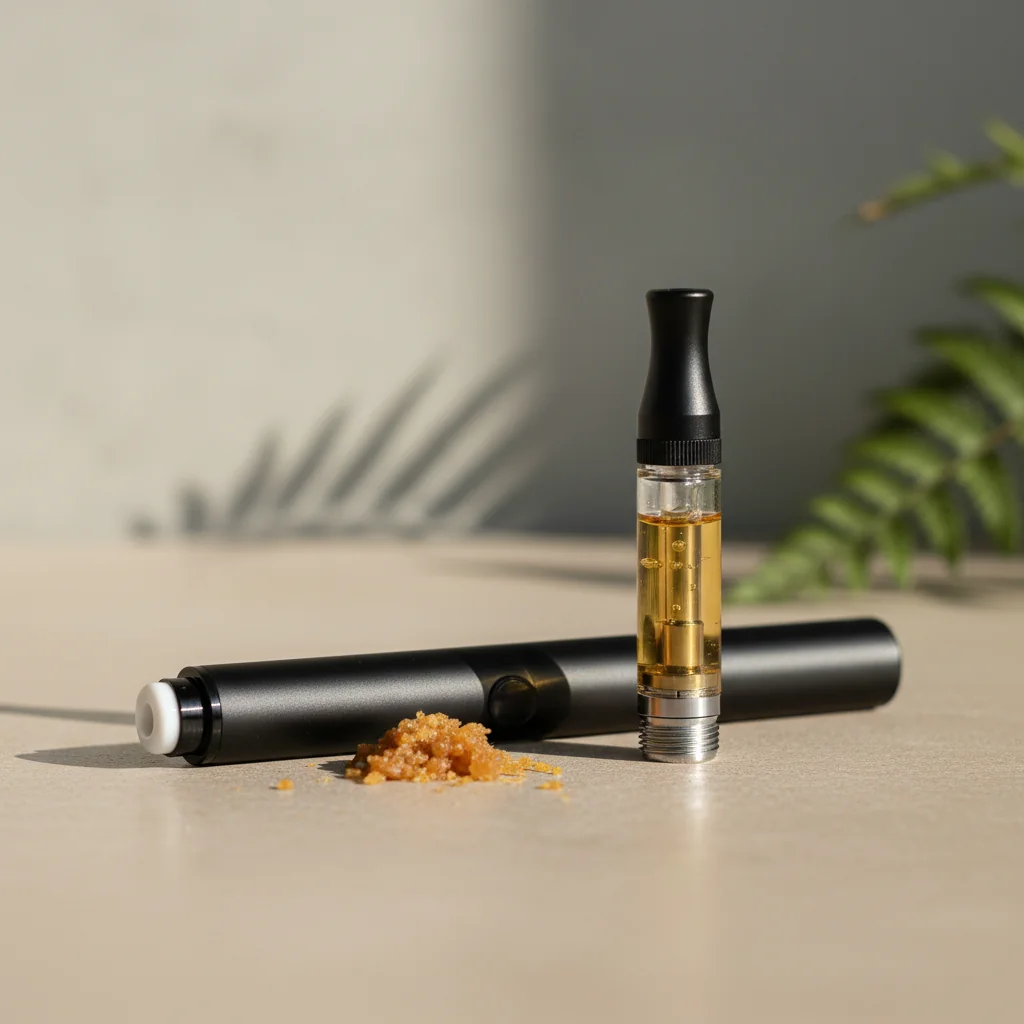
Dab pens and carts are the two main ways to vape cannabis concentrates on the go. They look similar — both are pen-sized, battery-powered, and produce vapor instead of smoke — but they're designed around fundamentally different ideas about convenience versus control. If you're choosing between them, the right answer usually depends on whether you prioritize flavor and concentrate variety or grab-and-go simplicity.
Quick Answer
A dab pen vaporizes raw concentrates like wax, shatter, and rosin that you load yourself; a cart (short for cartridge) is a pre-filled disposable container of distillate that screws onto a 510-thread battery. Dab pens offer better flavor, higher-quality concentrate options, and better cost efficiency for heavy users. Carts are easier, more discreet, and require zero maintenance. For occasional use, carts win on convenience. For regular use and flavor-focused users, dab pens win on quality and price-per-hit.
Table of Contents
- The Core Difference: Loaded vs Pre-filled
- Vapor Quality and Flavor Comparison
- Cost Comparison Over Time
- Maintenance and Reliability
- Common Mistakes
- Tips for Choosing Between Them
- Frequently Asked Questions
- Conclusion
The Core Difference: Loaded vs Pre-filled
The fundamental design split shapes everything else about how these two products perform.
A dab pen is a vaporizer with an open, refillable atomizer chamber. You load a small amount of concentrate — wax, shatter, rosin, badder, live resin — directly onto a heating element using a small dab tool. The atomizer is the vaporization component, and the battery body is separate. When the atomizer wears out (every 4-12 weeks), you replace it.
A cart is a sealed cartridge of cannabis distillate or concentrate-distillate blends that comes pre-filled from a manufacturer. The cart screws onto a 510-thread battery (a generic, standardized connector) using the threading at the base. When the cart is empty, you throw it out and screw on a new one. The battery itself is reusable across hundreds of carts.
The "510-thread" naming refers to the threading standard — 5mm length with 10 threads — that makes carts and batteries from different brands compatible.
Practically, this means a dab pen user buys a glass jar of wax (typically 1 gram) and refills the pen 30+ times from that single jar. A cart user buys 0.5g or 1g cartridges that each contain a fixed amount of distillate, and switches between cartridges when one runs out.
Vapor Quality and Flavor Comparison
The vapor experience is where dab pens and carts diverge most noticeably.
Dab pens produce more flavorful vapor because raw concentrates retain their full terpene profile. Live rosin and live resin in particular preserve the original strain's aromatic compounds — the diesel notes of a Sour Diesel, the sweet citrus of a Tangie, the gas of a Gelato. When you load these into a dab pen with a ceramic atomizer at moderate temperature (around 350-400°F), you taste the strain. The vapor is also thicker because raw concentrates are denser.
Carts typically use distillate, which is highly refined cannabis oil that's been stripped of most original terpenes during processing. Manufacturers add terpenes back in (either cannabis-derived or food-grade) to create the flavor profile listed on the cart. The result is usually a more uniform, candy-like flavor that's pleasant but doesn't capture the depth of raw concentrate. Higher-end carts use live resin or rosin as the source material, which dramatically improves flavor — these "live" carts cost more but get closer to dab pen quality.
Vapor cloud size is similar between the two when using comparable battery voltage. Where dab pens still edge ahead is in concentrate flexibility — you can switch between strains daily without buying multiple devices.
Cost Comparison Over Time
A heavy user saves significant money with a dab pen; an occasional user spends roughly the same on either path.
For a daily heavy user (1g of concentrate per week): - Dab pen path: $80 pen (one-time) + $40/g concentrate × 52 weeks = $2,160/year (year 1), $2,080/year (subsequent) - Cart path: $40 battery (one-time) + $50/cart × 52 carts = $2,640/year (year 1), $2,600/year (subsequent) - Difference: dab pen saves ~$500/year for heavy users, mainly because raw concentrate costs less per gram than equivalent quality cartridges
For a moderate user (1g of concentrate per month): - Dab pen path: $80 pen + $40/g × 12 = $560/year (year 1) - Cart path: $40 battery + $50 × 12 = $640/year (year 1) - Difference: dab pen saves ~$80/year — meaningful but not dramatic
For an occasional user (a couple sessions per week): - A 0.5g cart lasts 2-3 weeks, so 20-25 carts/year × $35 = $700-875/year - A dab pen with 4-5g of concentrate per year = $80 pen + $200 concentrate = $280/year (year 1) - Difference: dab pen saves more for moderate frequency, but the savings depend heavily on how much concentrate you buy
The cost analysis shifts when factoring in concentrate quality. Premium live rosin runs $60-80/g, which closes the gap with high-end live resin carts at similar prices.
Maintenance and Reliability
Carts win on maintenance because they have almost none. Dab pens require routine care.
Cart maintenance is essentially zero: keep the cart upright, store away from heat, screw it onto a charged battery. The cart is disposable. The battery needs charging every 5-10 days but is otherwise plug-and-play.
Dab pen maintenance involves three regular tasks: cleaning the atomizer (every 2-3 weeks, 5 minutes), replacing the atomizer (every 4-12 weeks depending on use, $10-25), and occasionally cleaning the threading where the atomizer connects to the battery. None of these are difficult, but they're not zero.
Reliability favors dab pens slightly. Carts can clog (a frequent complaint), develop air bubbles that interrupt vapor flow, leak when stored on their side, or crack if dropped. Counterfeit carts in unregulated markets are also a real safety concern. Dab pens have fewer points of failure once the device works reliably — the open atomizer rarely clogs, and the components are inspectable.
Discretion favors carts. They're slimmer, produce slightly less odor, and there's no concentrate to load in public. A dab pen with raw concentrate is harder to use casually because you have to load it somewhere private.
Common Mistakes
Both products have user-error patterns that ruin the experience.
Buying carts from unregulated sources. Counterfeit carts and gray-market carts have been linked to lung injuries (the 2019 EVALI cases). Always buy from licensed dispensaries with batch testing visible on the product.
Storing carts upside down or sideways for long periods. Distillate is viscous but moves over time. Carts stored sideways for weeks can leak around the mouthpiece or develop air gaps that interrupt the heating element.
Using a high-voltage battery with low-quality carts. Cheap carts have thin metal heating coils that can't handle 4.0V+ output. They burn out fast or produce a burnt taste. Stick to 3.2-3.7V output for most distillate carts.
Overloading a dab pen atomizer. A pinhead-sized amount of concentrate is plenty per session. Overloading wastes concentrate, leaks into the mouthpiece, and reduces atomizer lifespan.
Ignoring atomizer wear in dab pens. A worn atomizer produces burnt taste and weaker vapor. If your dab pen suddenly tastes off and isn't producing clouds, replace the atomizer before assuming the concentrate is bad.
Tips for Choosing Between Them
The decision typically comes down to four factors: how often you vape, how much you care about flavor, your budget pacing, and whether you want a refillable system or disposables.
Choose a dab pen if you: vape concentrate regularly, want access to live rosin and high-end concentrates, prefer terpene-rich flavor, are OK with light maintenance, and want lower per-gram costs over time.
Choose a cart battery if you: want maximum convenience, vape occasionally, prefer not to load concentrate, value discretion, and don't want to maintain a device.
Consider buying both. A 510-thread battery costs $20-40 and works with carts; a separate dab pen costs another $40-80. Many regular users keep both — a cart battery for daytime/discreet use, a dab pen for evenings or when they want to use raw concentrate from a special drop.
Don't overspend on either upfront. Beginners should start with a $40-60 dab pen or a $25-30 cart battery. Premium devices ($150+) are worth it after you understand your usage patterns.
Buy from licensed dispensaries only. Both dab pens and carts are subject to massive counterfeit and contamination problems in unregulated markets. Pay the legal-market premium for safety.
Frequently Asked Questions
Are dab pens stronger than carts?
Generally yes, but it depends on what you load. Raw wax and live rosin in a dab pen contain 70-85% THC and full terpene profiles. Distillate carts contain similar 70-90% THC but with reconstituted terpenes. The peak intensity is similar; dab pens just have more variety in what you can put into them.
Can you use a dab pen battery with a cart?
Sometimes, but it depends on the threading. Most dab pens use a different connection style than 510-thread carts. Some hybrid devices accept both, but a dedicated dab pen and a 510 cart battery aren't usually interchangeable.
Is a cart cheaper than a dab pen long-term?
For heavy users, dab pens are cheaper per gram of concentrate. For occasional users, the cost is similar. The dab pen advantage shows up most clearly when you start buying premium concentrates — live rosin in jar form is much cheaper than equivalent rosin carts.
Are carts safer than dab pens?
Both are safe when sourced from licensed dispensaries with batch testing. Both are risky when sourced from unregulated markets. The 2019 EVALI lung injury cases were tied to unregulated cart suppliers using vitamin E acetate as a thickener — a problem specific to black-market carts, not to vaporization itself.
What's the difference between a cart and live resin?
A cart is the form factor (a cartridge); live resin is a type of concentrate (made from fresh-frozen cannabis to preserve terpenes). You can buy a "live resin cart" — a cartridge filled with live resin instead of distillate. Live resin carts are significantly more flavorful than distillate carts.
Conclusion
A dab pen and a cart are both portable cannabis vaporizers, but they represent two different philosophies. Dab pens offer concentrate flexibility, better flavor, and lower long-term cost in exchange for some maintenance and a learning curve. Carts offer plug-and-play convenience, smaller form factor, and easier access at any dispensary in exchange for being limited to whatever's pre-filled. For regular users who care about quality and want to access live rosin or other premium concentrates, a dab pen is the right tool. For occasional users who prioritize ease and don't want to maintain a device, a 510-thread cart battery is more practical. Many regular cannabis users end up with both.
Frequently Asked Questions
Generally yes, but it depends on what you load. Raw wax and live rosin contain 70-85% THC. Distillate carts contain 70-90% THC but with reconstituted terpenes. The peak intensity is similar; dab pens have more variety.
Sometimes, but it depends on the threading. Most dab pens use a different connection style than 510-thread carts. Some hybrid devices accept both, but they're usually not interchangeable.
For heavy users, dab pens are cheaper per gram of concentrate. For occasional users, the cost is similar. The advantage shows up most when buying premium concentrates like live rosin.
Both are safe when sourced from licensed dispensaries with batch testing. Both are risky from unregulated markets. The 2019 EVALI cases were tied to unregulated suppliers, not to vaporization itself.
A cart is the form factor (a cartridge); live resin is a concentrate type (made from fresh-frozen cannabis). You can buy a 'live resin cart' — a cartridge filled with live resin instead of distillate.
Related Guides

510 Thread Batteries: Complete Guide to Vape Pen Batteries
Everything you need to know about 510 thread batteries for vape cartridges. Learn about voltage settings, battery types, features to look for, and how to choose the right battery for your cartridges.
Best Vaporizer Temperature Settings: Effects at Each Level
Comprehensive guide about best vaporizer temperature settings: effects at each level. Learn everything you need to know with expert tips and detailed instructions.

Conduction vs Convection Vaporizers: Heating Methods Explained
Understand the difference between conduction and convection heating in vaporizers. Learn how each method affects flavor, vapor quality, efficiency, and which is best for your vaping style.